
Economic Models
Economic models are intellectual constructs used by economists to simplify reality and highlight its most significant aspects. They provide a simplified representation of the cause-and-effect relationships between two or more economic variables. Economic models are tied to an economic theory. Typically presented as a mathematical model, usually a set of equations, they aim to test the ability of an economic theory to explain and predict economic events. An economic theory is deemed valid if it can explain economic facts and predict future economic trends. Therefore, an economic model is a tool to test the effectiveness of an economic theory. The economic model has two main objectives:
- Interpretation. An economic model should be able to interpret, explain, and represent the economic phenomena under study. This interpretation provides a causal explanation of current and past economic phenomena.
- Prediction. An economic model should be capable of forecasting the future trends of the economic phenomena under study. This involves projecting future economic events based on current and past economic data.
Economic models are logical-mathematical systems that represent a given economic theory. In comparison to the complexity of the real economy, economic models are constructed using mathematical simplification. For example, an economic model might consist of a set of equations and variables that define the constraints of a state and the tools available to policymakers. This mathematical simplification facilitates the dissemination of economic theory in political and media circles and aids its application in economic policy. In constructing an economic model, the economist eliminates all irrelevant details and external variables to focus solely on the relationships between variables affected by the economic phenomenon in question. Like any mathematical model, the economic model is characterized by dependent variables (endogenous variables) and independent variables (exogenous variables).
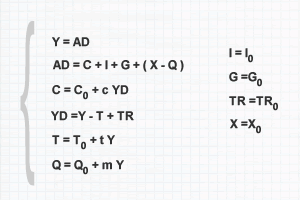
Income-Expenditure Model. The income-expenditure model is an example of an economic model. It provides an interpretation of macroeconomic phenomena and the relationship between the main economic variables of an economic system (income, consumption, investments, public spending, taxation). It is presented as a system of equations (mathematical model). Each equation determines the value of a variable.
Purpose of Economic Models. Economic models provide the opportunity to analyze economic reality, offer explanations for the causes of economic phenomena, and develop predictions for the future. They also play a crucial role in verifying the theory they represent. The ability of an economic model to interpret economic reality and predict the future determines the success or rejection of the economic theory it represents.


