
Cost Curves
Cost curves provide a graphical representation of economic costs and are a fundamental tool in economic analysis. In microeconomics, they are widely used to illustrate a firm's cost function and determine the optimal level of output (units of production).
What Is a Cost Curve?
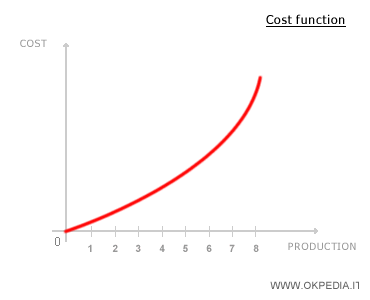
A cost curve is a graphical depiction of the total cost as a function of output, plotted on a Cartesian plane.
Types of Cost Curves
There are various types of cost curves, including the total cost curve, the average cost curve, the marginal cost curve, and curves representing variable costs or costs over different time horizons (short, medium, and long run).
Total Cost Curve
When referring to cost curves in general, the term typically denotes the total cost curve, which maps total cost to the level of production. The diagram below illustrates the total cost (TC) curve. As shown, the total cost curve is derived by summing fixed costs (FC) and variable costs (VC) at a given output level (Y).
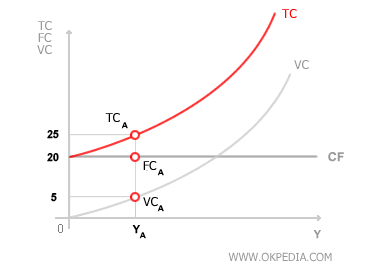
The total cost curve typically exhibits a U-shape due to the interplay between fixed and variable costs. The average variable cost (AVC) tends to rise as output increases, reflecting diminishing marginal returns, whereas the average fixed cost (AFC) declines since fixed costs are spread over a larger quantity of output.
Average Cost Curve
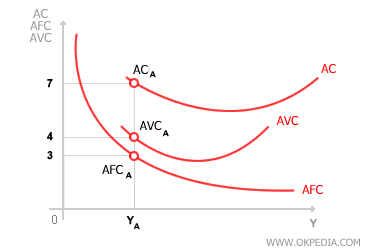
Another important cost curve is the average cost curve, also known as the unit cost curve. This curve represents the average cost (TC/Y) at different levels of output (Y). Like the total cost curve, it can be decomposed into its underlying components.
The average cost (AC) is the sum of the average fixed cost (AFC) and the average variable cost (AVC).
Marginal Cost Curve
Alongside total and average cost curves, microeconomic analysis frequently employs the marginal cost curve. The marginal cost (MC) curve represents the additional cost incurred from producing one more unit of output. Formally, it is defined as the change in total cost (ΔTC) resulting from a change in output (ΔY).
Since fixed costs remain constant, the marginal cost can also be expressed as the change in variable costs (ΔVC) relative to a change in output (ΔY).
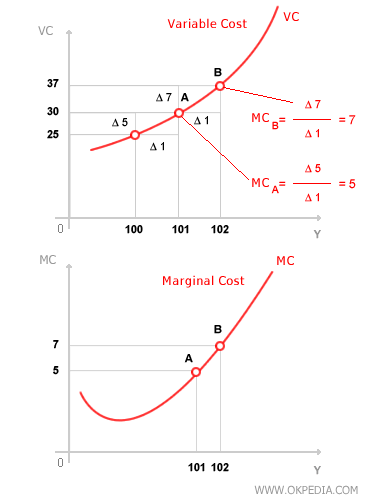
The area beneath the marginal cost curve represents the total variable cost of production. The marginal cost curve intersects the average cost curve at its minimum point: when marginal cost is below average cost, the average cost is decreasing; when marginal cost exceeds average cost, the average cost begins to rise. The point where marginal cost equals average cost corresponds to the firm's efficient scale, the level of output at which long-run average cost is minimized.


