
Subset
Given two sets, A and B, we say that set A is a subset of set B if every element in A is also in B.
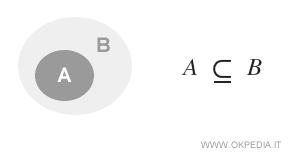
In this case, set A is entirely contained within set B.
In mathematical notation, this is written as A ⊆ B and read as "set A is a subset of B" or "set A is included in B".
Practical Example
A subset can be visually represented as follows:
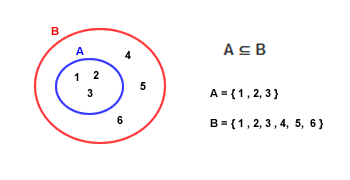
In the diagram, we have two sets, A and B.
- Set A contains the elements { 1, 2, 3 }.
- Set B contains the elements { 1, 2, 3, 4, 5, 6 }.
As you can easily see, set A is contained within set B. In other words, set A is a subset of B.
Normal vs. Strict Inclusion
The subset relationship can be normal or strict.
- Normal Inclusion (A⊆B)
In normal inclusion, the sets can be equal (A=B). The two sets might even be identical.
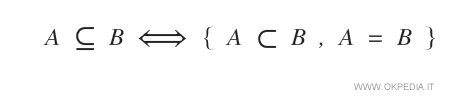
A subset with a normal inclusion relationship is called:- a proper subset if the two sets are different (A≠B)
- an improper subset if the two sets are the same (A=B) or if the subset is empty (A=∅).
Practical Example
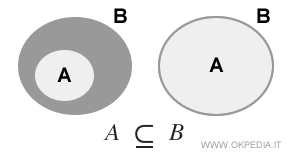
- Strict Inclusion (A⊂B)
In strict inclusion, the sets cannot be equal. The two sets are different (A≠B). Therefore, there are elements in set B that are not in set A. In such cases, we say that "set A is strictly included in B" or "set A is strictly contained in B", and it is denoted as A ⊂ B.
A non-empty subset with a strict inclusion relationship is always a proper subset because the two sets are different.
Practical Example
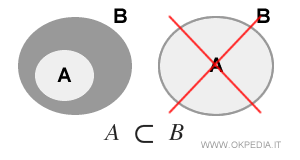
Note. Strict inclusion (A⊂B) is always also normal inclusion (A⊆B). However, normal inclusion (A⊆B) is not necessarily strict inclusion (A⊂B) because the two sets might be identical.


