
Cross Elasticity
Cross elasticity describes the relationship between the quantity demanded of one good and the price of another. For two goods, A and B, cross elasticity is calculated as the ratio of the percentage change in the quantity demanded of good A to the percentage change in the price of good B. In essence, it is a variation of demand elasticity applied to different goods.
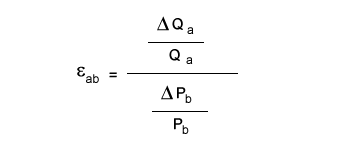
Using calculus, the cross elasticity of demand can be determined by taking the derivative of the demand function \( Q_a \) for good A with respect to the price \( P_b \) of good B. Cross elasticity is a key tool for analyzing the relationship between two goods. The main scenarios are as follows:
- Substitute goods: A positive cross elasticity (\( \epsilon > 0 \)) indicates that the goods are substitutes. In this case, an increase in the price \( P_b \) of good B leads to a rise in the quantity demanded \( Q_a \) of good A, and vice versa. For example, if the price of butter becomes too high, consumers may switch to margarine. Similarly, beef and pork are substitute goods; when the price of beef increases, demand for pork typically rises, assuming all else remains constant.
- Complementary goods: A negative cross elasticity (\( \epsilon < 0 \)) signifies that the goods are complements. Here, an increase in the price \( P_b \) of good B results in a decrease in the quantity demanded \( Q_a \) of good A, and vice versa. For instance, if gasoline prices rise, demand for complementary goods like cars may fall.
- Independent goods: A cross elasticity of zero (\( \epsilon = 0 \)) indicates no relationship between the two goods. This is the most common scenario in everyday life, where changes in the price \( P_b \) of good B have no effect on the quantity demanded \( Q_a \) of good A.
In summary, cross elasticity measures how the quantity demanded of one good changes in response to a change in the price of another. This concept is particularly valuable for classifying goods across industries and market segments, as well as for evaluating a company’s market competition.
 Cross Elasticity of Supply: Cross elasticity can also be applied to supply. In this context, the cross elasticity of supply examines the relationship between the quantity supplied of one good and the price of another.


