
Hicks Method
The Hicks method is a way to measure the income and substitution effects following a price change. When the price of good X1 increases, the consumer shifts from basket A to basket B. This adjustment reflects the consumer’s response to the change in relative prices by altering their optimal choice. Basket B represents the final equilibrium point of the price effect, which combines both the substitution effect and the income effect. In this new equilibrium, the consumer ends up on a lower (less desirable) indifference curve compared to the initial one.
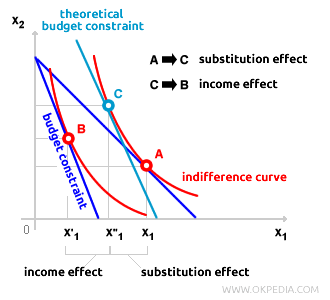
To separate and measure these two effects, Hicks proposes shifting the new budget line—reflecting the updated price ratio—until it becomes tangent to the initial indifference curve. This adjusted budget line, shown in light blue in the graph, is called the theoretical budget constraint. This process identifies a third basket, C, which isolates the substitution effect of the price change. The graphical representation and the interpretation of the effects using Hicks' method can be summarized as follows:
- Substitution Effect: The movement from the initial basket A to the theoretical basket C represents the substitution effect. Basket C lies on the same initial indifference curve but corresponds to a budget line that already accounts for the price change. This allows the substitution effect to be examined independently of the income effect.
- Income Effect: The shift from the theoretical basket C to the final basket B represents the income effect. This transition occurs without changing the slope of the budget line, meaning relative prices remain constant. This allows the income effect to be measured in isolation from the substitution effect.
In summary, the Hicks method provides a clear framework for analyzing and separately measuring the income and substitution effects of a price change by introducing a theoretical third basket that remains on the initial indifference curve, maintaining the same level of well-being.
 Slutsky Method: An alternative approach to analyzing the income and substitution effects is the Slutsky method, which identifies a theoretical third basket by holding real income constant. The Slutsky method differs from the Hicks method in how the third basket is defined: Slutsky maintains constant real income, whereas Hicks ensures constant well-being.


